Few exercises look as simple as a tire flip. You squat, stand up, and shove a giant tire over. Yet the same movement shows up in strongman injury reports, and that gap between how easy it looks and how much it demands is why this guide exists.
Tire work is also spreading well beyond strongman shows. In July 2026, two rival high school football teams in Bristol, Tennessee, held their annual tire flip down State Street, and one coach described the hard part as mostly mental. That matches what many lifters report: the movement can be learned quickly, but staying composed under a heavy tire takes longer. If you want to flip tire reps safely, the details below matter more than effort.
What a Tire Flip Actually Asks of Your Body
In a study published in the Journal of Strength and Conditioning Research, five experienced lifters performed two sets of six flips with a 232 kg tire. The duration of the second pull was a key factor in flip performance, and the exercise produced a high level of physiological stress. Five lifters is a small sample, so treat it as a useful snapshot rather than the final word. It does help explain why flip tire sessions feel so draining.
The lift recruits a lot of muscle. Fitbit’s guide describes it as posterior chain work for the hamstrings, back and glutes, which can suit people who sit most of the day. Healthline also lists the quads, calves, lats, traps, biceps, triceps and forearms, with the abs working to stabilize.
A deadlift is a helpful comparison. A barbell is balanced, rigid and predictable. A tire is bulky, shifts in your hands and can be slick. One exercise guide says the tire’s awkward shape adds instability and can make the movement harder than conventional lifts like squats or deadlifts. It is reasonable to expect that a technique flaw a barbell might tolerate will show up faster with a tire.
Where Flip Tire Injuries Tend to Happen
Strongman injury data points to two trouble spots. A case report in the International Journal of Sports Physical Therapy cites figures showing that the low back was the most common injury site at 24 percent, followed by the biceps and knee at 11 percent each, and that biceps injury is more common in strongman athletes than in weightlifting, powerlifting or bodybuilding. The same report describes a 39 year old competitor who ruptured his distal biceps tendon during a training tire flip.
The biceps risk has a clear technical explanation. Coaches interviewed by 8WeeksOut say that gripping the center of the tire from a sumo stance keeps your chest off the rubber and puts the strain on your biceps. The back problem has a similar cause. Spartan’s trainer sees lifters using too much lower back and too little leg drive, often because the start position was wrong. Both injuries trace back to flip tire setup, which is good news, because setup is something you can fix.
Tires are not uniquely dangerous. A systematic review of distal biceps tendon rupture found heavy weightlifting was the mechanism in 53.2 percent of cases. If you have a history of biceps or lower back trouble, it is worth speaking with a physiotherapist before you start.
A Walkthrough That Starts Before You Touch the Tire
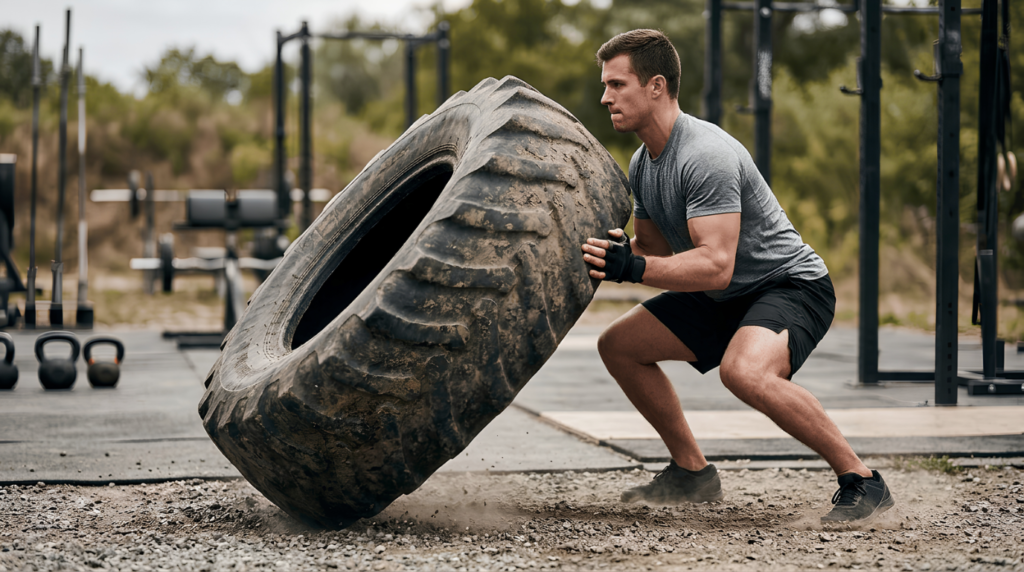
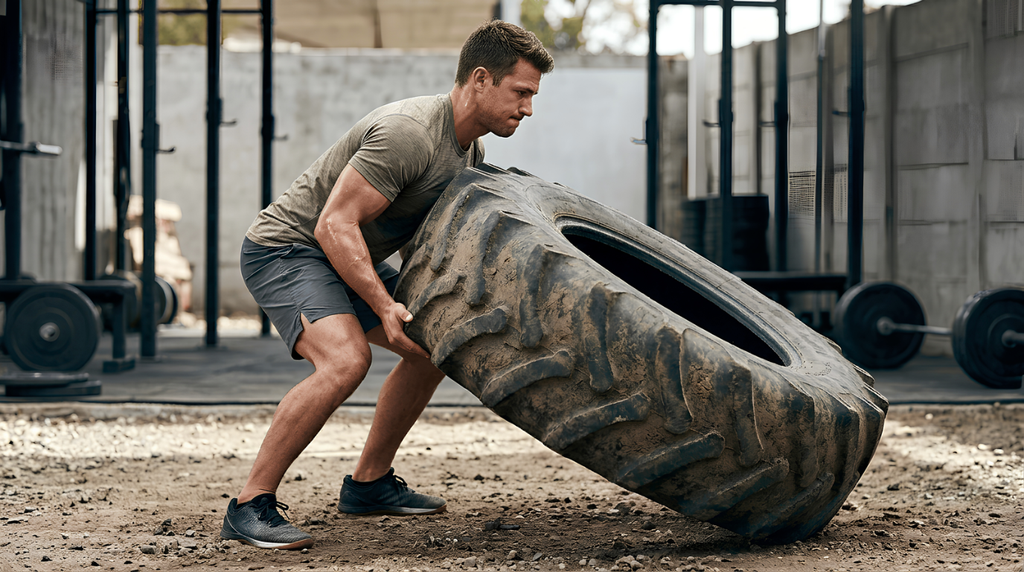
Good flip tire technique begins with where you stand. Your shins should touch the tire at the start. Spartan’s guidance is to squat with your hips lower than your shoulders, take a wide grip with your fingers dug under the tire, and lean your chest into it.
Then you drive. Extend through the hips, knees and ankles until the tire reaches about 45 degrees, then step forward, drive a knee into the tire, move your hands to the upper part and push it over. Think of it as pushing the tire up and forward in one motion, not lifting it straight up. If you do not commit, the tire stalls and comes back down.
A simple self check: film one set from the side. Look at whether your chest meets the tire before you stand, and whether your hips rise faster than your shoulders. If the hips shoot up first, your back is probably doing work your legs should be doing. A qualified strength coach can confirm what you see.
Picking a tire you can control
Before you flip tire loads for the first time, find out what the tire really weighs. Healthline notes that estimating tire weight is not an exact science, and suggests weighing your truck with and without the tire at a CAT scale. Fitbit says tractor tires range from 100 to 500 pounds, that the heaviest are not for beginners, and that you should practice with a lighter tire and have about six months of training behind you. Spartan’s trainer adds that shops often pay to dispose of old tractor tires, so calling around may get you one for free if you can haul it.
Safety details people overlook
A few practical points matter in any flip tire session. Wet rubber is slippery, your knee needs protection as it drives under the tire, and fingers can get caught during aggressive flipping. Fitbit recommends a warm-up of about ten minutes of bodyweight squats, lunges and chin-ups.
Training Ideas, Alternatives and Context
How heavy you go should depend on your goal. One lifter’s guide suggests heavy tires for strength and lighter tires for multiple fast flips. For flip tire training aimed at strength, keeping sets short is a sensible approach, since the injury report above suggests biceps fatigue may limit force transfer. This is practical reasoning, not a studied prescription, so a coach should adjust it to you. A good rule is to stop the set when your form changes, not when the tire beats you.
If a tractor tire is not available, you can still train the pattern. WellTech lists the squat and throw as a beginner alternative that works the glutes, core and shoulders. Some gyms have machines like the TireFlip 180, which offers adjustable loads from 100 to 160 pounds.
Records show the two extremes. Jean-Francois Caron flipped a 1,350 pound tire four times at the Arnold Strongman Classic. At the other end, a 2021 Guinness record in Newcastle had a men’s 12 hour flip with a 100 kilo tire covering 10.725 kilometres. One is about maximum load and the other about endurance, and neither is a sensible target for a first session.
Treat every flip tire attempt as a skill session first and a strength test second. Start light, keep your chest on the rubber, and let the weight climb only when the movement looks the same on rep five as it did on rep one.