Most gyms keep a decline bench in some far corner, and it is usually the one nobody is waiting for. It has devoted fans who swear by it for a fuller lower chest, and plenty of skeptics who call the angle a gimmick. The research sits somewhere in the middle, and knowing where is more useful than picking a side.
What the Angle Actually Changes
The lower chest is not a separate muscle. The pectoralis major has an upper clavicular portion and a larger sternal portion that attaches along the breastbone, and the lower fibers belong to that sternal part. On a decline bench, the bar travels toward your lower chest, which lines up better with those fibers. A 2023 systematic review in Applied Sciences found that decline pressing tends to raise sternal activation compared with flat pressing, while lowering upper chest emphasis.
Earlier lab work points the same way. In a study of fifteen experienced male lifters comparing a 30 degree incline press with a 15 degree decline press, the decline showed significant lower chest activity, while upper chest activity looked similar between the two.
Now the caution. A roundup published in late August 2026 highlights an acute study of competitive bench press athletes lifting at 6RM, where pec major surface activity did not differ significantly between flat, 25 degree incline and 25 degree decline pressing. Electrical activity in one session is not muscle growth over months, and that same article is careful to say the result cannot show whether decline pressing is better for lower chest growth. The fair summary is that the decline bench probably shifts emphasis a little, while long term growth evidence is still thin.
Where the Decline Bench Earns Its Place
Its best argument is comfort. Lying with your head lower makes it hard to arch aggressively, so the lower back stays quieter. The decline bench press also loads the front delts less than flat or incline pressing, and triceps activation is similar to a standard flat press. That makes it a reasonable option for lifters whose shoulders complain on other angles, without giving up arm work.
Picture a lifter whose front shoulder pinches on flat pressing. Swapping one flat session for decline work for four to six weeks, while logging load, reps and how the shoulder feels, is a sensible experiment. It will not fix every shoulder problem, and pain that sticks around deserves a proper assessment from a physio or doctor, but the test costs very little.
There is one trap. The decline angle makes it easy to shorten the range of motion and lift heavier weights, so chasing numbers alone can cost you the stretch at the bottom of the rep. Lower the bar slowly, touch it lightly to the chest, and press without bouncing.
Lying head down also does not suit everyone. People with high blood pressure, eye conditions such as glaucoma, or reflux may find it uncomfortable or unsuitable, so check with a doctor first. This point should be backed by a medical source before publishing.
Setting Up Without Sliding or Stalling
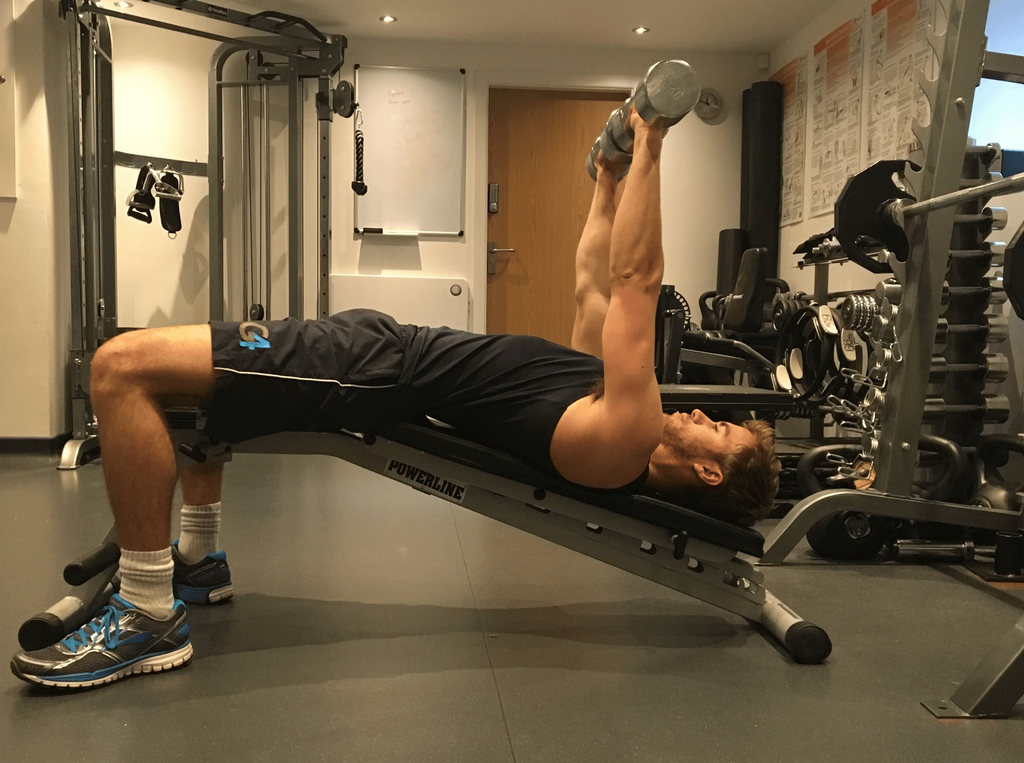
Set the bench between 15 and 30 degrees of decline. Steeper does not mean better, it mostly makes the lift awkward. Hook your feet under the pads before you lie back, because an unsecured lifter will slide.
Safety is the bigger issue. You cannot roll a failed bar down your belly on a decline, so set the safety arms or use a spotter, and agree on a hand off before the first rep. If you train alone, dumbbells are the safer choice, and a decline machine is safer still.
A sensible starting point is two to three sets of six to twelve reps with a weight you can control. I would treat it as a secondary lift after your main flat or incline work, not the first exercise of the day.
Fitting It Into a Real Training Week
If you train chest twice a week, one workable layout is a heavy flat or dumbbell press on day one, then incline work followed by three sets of decline bench press on day two. That is an illustration, not a prescription, and volume should match your recovery and experience.
No bench in your gym, or a permanent queue for it? Forward leaning dips, a decline machine press or a cable press that travels downward all cover similar ground. The trade-offs differ. Dips require you to control your own torso and shoulder girdle, while a supported decline press makes load easier to manage and progress in small jumps, such as 2.5 kg.
Whichever you choose, judge it over six to eight weeks rather than one session. Keep it if your pressing or shoulder comfort improves, and drop it if neither does.
Quick Answers
Is the decline bench better than flat?
No, it is a different emphasis, and flat pressing remains the broader strength builder.
Is the decline bench press fine for beginners?
Yes, with light dumbbells or a machine, secured feet and a spotter, once the movement pattern feels stable.
Will it guarantee a bigger lower chest?
No. Consistent progressive overload on any angle matters more than which bench you pick.
Sources to add before publishing: the 2023 Applied Sciences systematic review on bench angle and pectoralis major activation; the study on bench angle and upper body muscle activation that compares incline and decline pressing (the 2016 paper by Lauver and colleagues is commonly cited, so confirm it before linking); the two papers listed in the August 2026 analysis (PMC5504579 and PubMed 17326698); and a medical source on head down positions, blood pressure and eye pressure.