A T-bar row machine takes up real floor space and, at the higher end, a lot of money, so it helps to know what you are actually paying for. The movement itself is simple. You hold a handle on a weighted lever and row it toward your torso. What changes from machine to machine is how much your lower back is involved, how many grip options you get, and whether the thing will fit in your room. This guide draws on manufacturer specifications and published articles, and it points out where you should verify details before spending.
What a T-bar row machine trains, and what it leaves out
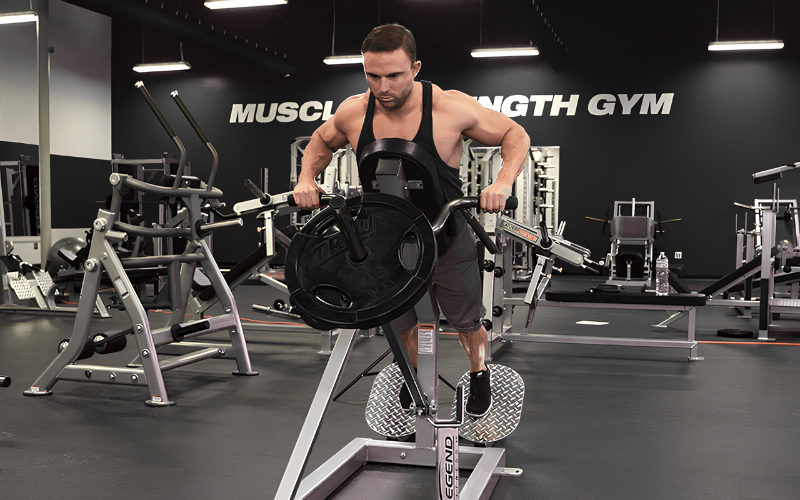
A plate-loaded T-bar row machine guides the weight along a fixed arc. The main work lands on the upper and mid back, meaning the lats, rhomboids and trapezius, with the biceps and rear shoulders assisting. One UK equipment retailer adds that the core is engaged and that beginners may find good form easier here than on a barbell row.
The fixed arc of a T-bar row machine is the trade-off worth understanding. You spend less effort balancing the bar, so more of your effort goes into pulling. You also lose some of the whole-trunk bracing a free barbell row demands. Neither is better in the abstract. It depends on whether you want a back exercise or a lift that also trains your trunk.
Be careful with big promises. A September 2026 BoxRox article points out that an electromyography reading describes muscle activity during a set and cannot prove that one variation builds more muscle over months. The same caution applies to claims about any T-bar row machine on a sales page.
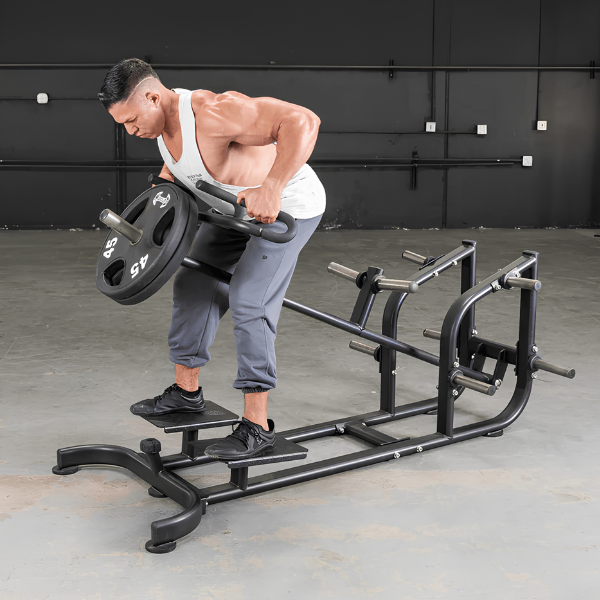
Standing or chest supported?
Standing T-bar row machine designs are what you will see in most commercial gyms. You hinge forward, brace, and row, so your hips and spine help hold the position. Chest supported designs let a pad hold your torso, which takes the lower back out of the equation.
Picture a lifter whose lower back is already tired by the third set of heavy rows. On a standing machine, the fourth set may end because of the spine. On a chest supported T-bar row machine, the back muscles are more likely to be the limit. That is a thought experiment, not a research finding, but it shows why the choice matters. Anyone with an existing back problem should ask a clinician before picking either design.
If space or budget rules out a machine, a barbell in a landmine attachment with a V handle copies the movement and usually costs less. A dedicated T-bar row machine saves setup time, which is the real advantage over that workaround.
Reading the spec sheets
Published numbers show how different each T-bar row machine can be. Rogue lists a 76 by 39.75 inch footprint, a 1.88 inch post, and delivery fully assembled. Body-Solid lists 79 by 42.5 by 18.75 inches, 163 pounds, and 11 gauge steel, though the page reviewed carried a 2023 ship date, so confirm it is still sold and check the current price.
At the chest supported end, Power Lift lists its model at 2,999 dollars on an Australian retailer’s page, with an extra large chest pad, a ratchet seat, and a weight of 325 pounds. Check which currency that price is in before comparing. SQMIZE claims a 300 kg capacity, including 200 kg of plates, plus ten handle positions on its TBR44i, according to a German retailer. These are manufacturer claims, not independent tests.
Before ordering any T-bar row machine, run a few practical checks. Measure the footprint plus room to step on, load plates, and step off. Check that your plates fit the post. Olympic style plates have a hole of roughly 2 inches, so a 1.88 inch post is a sensible match, but confirm with the maker. Consider the weight too, since 163 to 325 pounds matters for stairs and floors. Finally, look at handle options if you want to rotate between wide and narrow grips.
Using it well
The classic fault is turning the row into hip extensions. The hips shoot back, the bar jerks up, and the weight drops. The back does little and the lower spine takes the load. If you cannot keep your torso angle still, lower the weight. Pull toward the lower chest, squeeze the shoulder blades together at the top, and lower under control.
Many lifters train rows for eight to twelve reps when chasing muscle size, but that is a convention rather than a rule. A T-bar row machine usually works best after your heaviest compound lift, when you can still hold form without needing to be fresh.
A seated cable row is easier to adjust in small steps, while a plate loaded T-bar row machine may suit heavy, steady sets better. Many lifters keep both in rotation instead of choosing one.
Prices and availability change often, so confirm current figures with the seller before you buy.