The World Championships in Rotterdam began on October 17 and run through October 25. Of all the apparatus on the program, gymnastics balance beam is the one most likely to rewrite the standings. A gymnast can do almost everything well and still lose a medal in a few seconds. This guide covers what the event demands, what this season’s results suggest, and what everyday exercisers can borrow from it.
What a beam routine asks of an athlete
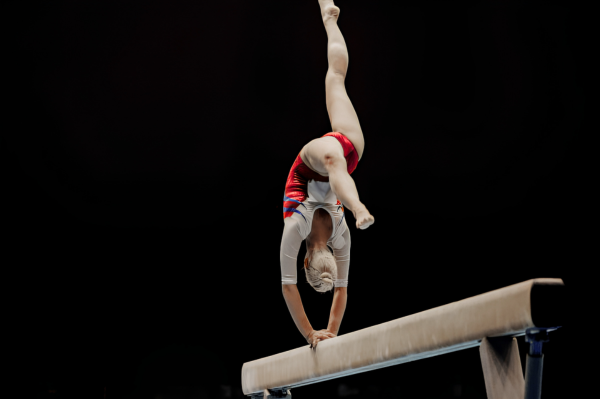
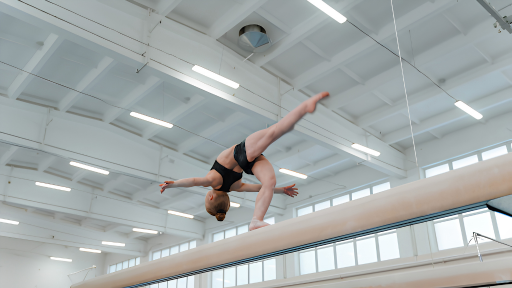
The apparatus is about 16 feet long and 4 inches wide, and it sits roughly 4 feet off the floor. Routines last up to 90 seconds and combine acrobatic skills, leaps, turns and a dismount. Scoring in gymnastics balance beam competition has two parts. The difficulty score reflects what the gymnast attempted. The execution score starts at 10 and drops with every flaw in form or balance. A fall costs an extra full point.
That structure creates a real strategic choice. Adding another flip raises difficulty slightly, but it also adds another landing that can go wrong. In a team final, where one fall can sink a score, the safer routine is often the smarter one.
Why the acrobatic series is where routines break
The Asian Games showed this clearly. China won team gold with 166.462, and beam was among its strongest events at 44.266. Yet in qualification, Ke Qinqin fell first, then Zhang Qingying fell on her acrobatic series, and Japan edged ahead in the standings.
The reason is mechanical. In an acrobatic series, the gymnast takes off, lands on a surface she cannot see, and must go straight into the next skill. There is no time to correct a small error on the first landing, which helps explain why a fall in the middle of a series is so costly. Even a team as deep as China is not protected from this. Gymnastics balance beam punishes hesitation as much as it punishes mistakes.
The individual final went to Hwang Seohyun of South Korea with 14.700, ahead of Qiu Qiyuan on 14.566, after another fall from Zhang. Sometimes the title simply goes to whoever stays on.
Names to follow in Rotterdam
Algeria’s Kaylia Nemour has been one of the steadiest beam performers this year. She took silver in Cottbus and Baku before winning gold in Cairo. That Cairo score was 14.266, ahead of China’s Ke Qinqin on 13.166. Check the official start lists to confirm she competes in Rotterdam, because entries can change.
In Europe, France’s Elena Colas won beam at the continental championships in Zagreb, with Italy’s Manila Esposito second and Angelina Melnikova third. Brazil adds two more names. At the Szombathely Challenge Cup, Flavia Saraiva won beam with 13.766 and Rebeca Andrade took second with 13.600.
For the United States, a late September preview projected Charleigh Bullock, Claire Pease and Hezly Rivera on beam, with Jade Carey as the backup. That was written before national trials, so treat it as a projection until the final team is confirmed. Anyone tracking gymnastics balance beam results this week should keep the federation’s start lists open beside the broadcast.
How to watch a beam final like a judge
Start with the difficulty figure when it appears, since it shows how much room the gymnast has for error. A high start value means a small wobble may not cost the medal. Next, watch the links between skills rather than the skills themselves. Pauses and rebalancing between elements are where marks quietly leak. Finally, watch the feet on the dismount. A stuck landing and a two step lunge can follow the identical skill and score very differently.
One caution helps when reading numbers. Comparing gymnastics balance beam scores across different meets tells you less than it seems to, because the routines, judging panels and difficulty values all differ. Hwang’s 14.700 and Nemour’s 14.266 were earned in different competitions and are not a ranking of the two.
What the gymnastics balance beam teaches the rest of us about balance
You do not need a four inch beam to borrow from this sport. Elite gymnastics balance beam training rests on ankle stability, core control and body awareness, and all three matter for ordinary fitness.
A few simple drills show the idea. Stand on one foot while you brush your teeth. Walk heel to toe along a strip of tape on the floor, first forward and then backward. Hold a single leg stand while looking at a fixed point, then slowly turn your head. Keep a wall or chair within reach, and make each drill harder only when the last one feels easy. If you have had an ankle or knee injury, or you are worried about falls, ask a physiotherapist before progressing. Children who want to try the sport should work with a qualified coach rather than copying routines from video.
Quick answers
How wide is the beam?
A standard gymnastics balance beam is about 4 inches, or 10 centimeters, wide. That leaves very little room for a misplaced foot.
How long is a routine?
A gymnastics balance beam routine can last up to 90 seconds. Going over the limit brings a deduction.
Can beginners try it?
Yes, and they rarely start high. Many clubs begin newcomers on a low gymnastics balance beam or on a line marked on the floor, so the skills can be learned without the fear of falling.