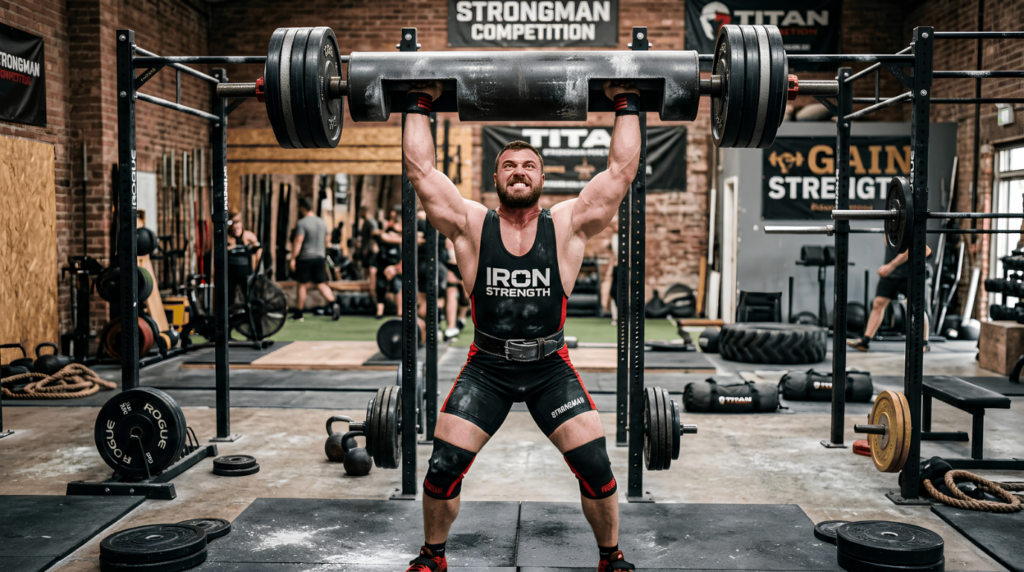
Two men tried to press 232 kg overhead in Glasgow on Saturday 17 October, and neither completed it. Ondřej Fojtů came closest, leaning far back before his arms gave out, and he still shared the World Log Lift Challenge title with Jack Forgacs at the Giants Live World Tour Finals. Iron Biby’s world record of 231 kg, set in Birmingham in 2024, is still intact.
Watching lifts like that makes plenty of people want a log in their own gym. A strongman log bar is a good way to learn the movement, but the options differ more than the product pages suggest. This guide covers how they differ, what they cost, and how to learn the lift without getting hurt.
What the Glasgow Field Shows
Giants Live described the field as perhaps the deepest the event has had, with six men pressing 200 kg. Only Fojtů and Forgacs went past 210 kg before both tried the record weight. At the same event last year Forgacs pressed 222 kg for a British record, and Fojtů locked out 220 kg for a World Junior Record.
Those are competition logs and competition loads, and they are a different kind of equipment from what most of us will own. At this year’s Arnold Strongman Classic, athletes pressed logs of 195 kg and 175 kg for reps. A home strongman log bar is a training tool, and Titan, for one, says plainly that its bars are not meant to be dropped.
How a Log Differs From a Barbell and an Axle
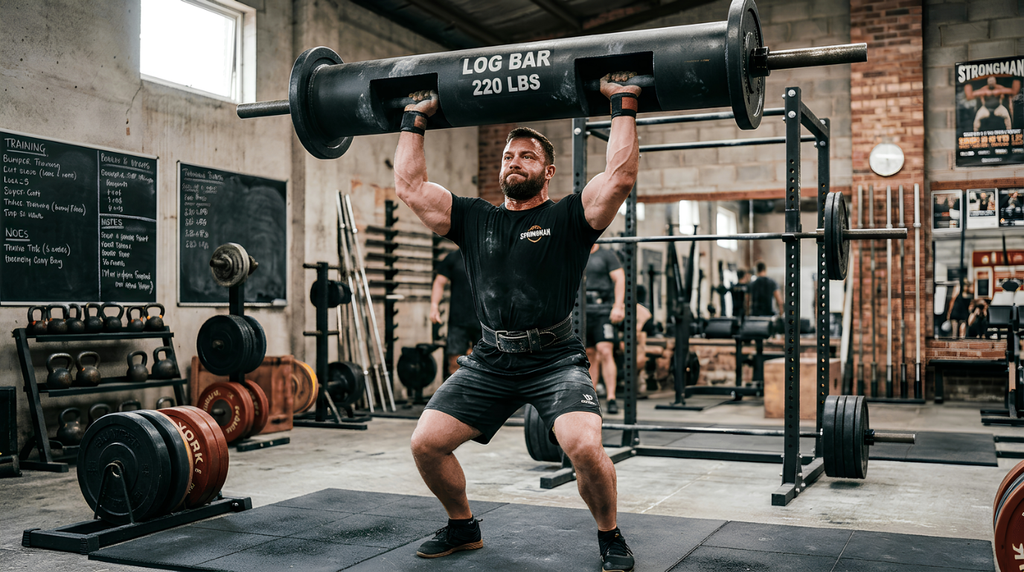
Your hands sit in a neutral position inside a steel barrel, with the weight out in front of your chest. That changes the clean. The log has to be rolled up the body and tucked against the hips, then driven to the shoulders with the elbows high. Writers at Elitefts have called the log press the bench press of strongman, and the comparison fits, because a heavy press depends on a clean setup.
An axle is a thick straight bar. One strength-shop guide describes it as better for grip-heavy overhead work, while the log asks for its own clean, rack position and lockout. A standard barbell lets you keep the bar close to your body the whole way up, which is exactly what a strongman log bar does not allow.
Titan describes the neutral grip on its strongman log bar as easier on the shoulders. That is a manufacturer’s claim, so if you have a history of shoulder trouble, ask a physio or coach before treating it as a guarantee.
What to Check Before You Buy a Strongman Log Bar
Diameter. Retailers sell the strongman log bar in 8, 10 and 12 inch versions. Valor Fitness lists its steel boxes at 59, 69 and 92 pounds for those sizes and recommends the 8 inch for beginners. If you plan to compete, pick the size your event uses. Robert Oberst’s advice is to learn the log’s width, height and handle spacing in advance and train on something close. One reviewer who trains strongmen and strongwomen says most competitions use an 8 inch log for women. Confirm that against your own federation’s rules before relying on it.
Empty weight. This sets your lightest possible load. The same reviewer said the smallest log their gym owned was 90 pounds, which is a heavy place to start for many lifters, and that a 55 pound bar made practice much easier. For comparison, Titan’s bar is 75 pounds, Rogue’s 10 inch is 72 pounds, Gymleco’s is 32 kg and SQMIZE’s is 50 kg. A 50 kg strongman log bar is a serious weight before you add a single plate.
Handles. Handle thickness on a strongman log bar varies more than you might expect. SQMIZE lists 29 mm, Gymleco 30 mm and Titan 1.65 inches, which is about 42 mm. Spacing differs too. Gymleco and SQMIZE both list 62 cm between handles, while Titan lists 26 inches, about 66 cm. A thicker handle taxes your grip harder, so if your hands are small, try to hold one before ordering.
Sleeves. Rogue warns that its 1.9 inch sleeves need specialty axle collars, and some standard barbell collars may not work. Titan says its bar accepts competition plates and has 14.25 inch sleeves. Check what plates and collars you own before you buy. As a loading example, a 75 pound bar with two 45 pound plates comes to 165 pounds.
Rackable or not. Titan sells rackable versions that can sit in a power rack. An Elitefts article on log training notes that starting from a rack removes the clean, which is useful for speed work. It also removes the part of the lift beginners most need to practise, so use it as a supplement.
What Home Bars Cost Right Now
Titan’s rackable strongman log bar models list at $239.97 for the 8 inch, $259.97 for the 10 inch and $319.97 for the 12 inch. Rogue’s 10 inch LB-1 is built from 11 gauge steel tube and is listed as tested to 1,000 pounds. Its European store shows about 525 euros before VAT, with CA$747 in Canada and A$874.50 in Australia.
Those figures come from retailer pages seen in October 2026, and prices change often, so check the current listing. Cheaper strongman log bar options exist, such as Orion’s 25 kg and 32 kg models. Compare handles, sleeves and empty weight against the checklist above rather than price alone.
Learning the Lift: Pick, Clean, Press
Rob Kearney breaks the log lift into three parts: the pick, the clean and the press. Luke Stoltman calls it one of the most technical lifts in the sport and says the push press is the simplest way to finish it for most people. Kearney himself uses a split jerk, which is harder to learn.
Elitefts lists several mistakes worth fixing early. Do not rush the pick, because a deliberate start gives better position for the clean. Grab the handle dead center and tilt the log forward as you grip it. Keep your elbows high as the log reaches your lap, and do not try to get under the press too quickly. A rule from the Primal Training Systems method is also worth borrowing: if you cannot clean a weight, you cannot press it, so keep your press weight at or below your clean.
For a starting point, one strength-shop guide suggests sets of one to three reps on heavier days. Treat that as a single source rather than a prescription and adjust with a coach.
Safety needs planning. Elitefts advises that if a press drifts behind you, let go and step forward instead of fighting it. Use a drop pad if you must lower from overhead. Oberst’s advice applies at home too: if your contest cleans from pads, train from pads, and if it cleans from the floor, train from the floor.
Matching the Bar to the Lifter
A beginner with a standard home gym is best served by an 8 inch strongman log bar with a low empty weight and sleeves that take plates you already own. Someone preparing for a specific contest should find out that event’s log size and handle spacing first, then buy the closest match. A lifter with a rack and a goal of heavier overhead work can look at a rackable strongman log bar, as long as the clean stays in the programme.