Most people buy a chin up assist band expecting it to lead straight to their first unassisted rep. For some it does. For many others it turns into a comfortable plateau: ten easy banded reps, and then nothing the day the band comes off. The gap usually isn’t effort. It comes down to how the band is chosen and how it fits into the rest of your training.
What the Band Actually Does to the Movement
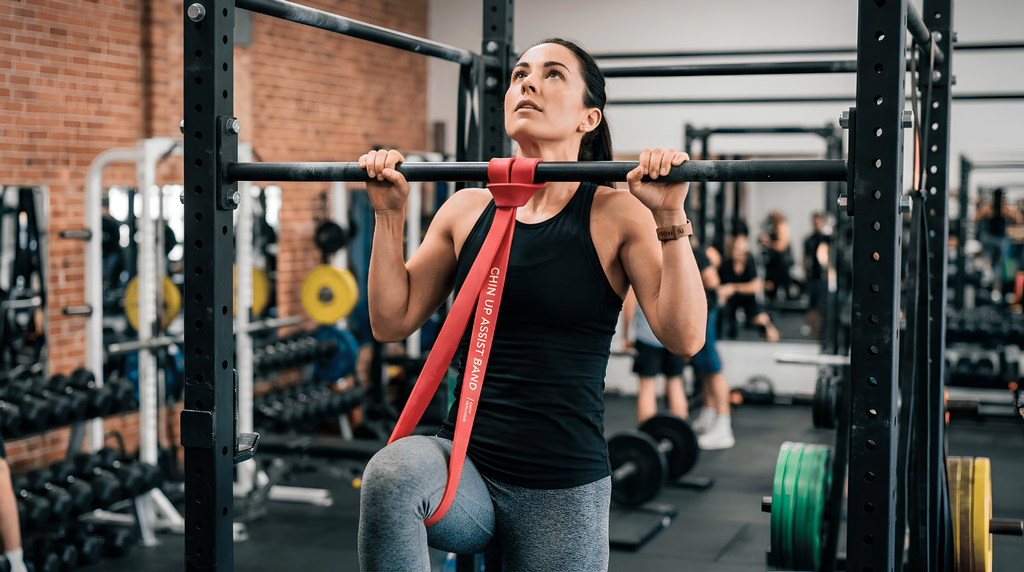
A looped band is elastic, so it stretches most when you hang with straight arms and shortens as you rise. Help is therefore largest at the bottom of the rep and smallest at the top. For a beginner stuck at the dead hang, that is genuinely useful.
The trade-off is worth understanding. The hardest part of a chin up for many people is the start, and the band takes the most load off exactly there. Ten banded reps tell you how well you can move through the pattern, but they say much less about whether you can lift your full bodyweight from a hang. Treat the band as a way to practice the movement, not a scoreboard.
The top of the rep is a different story. Because help fades there, you still have to finish the pull yourself, which makes a chin up assist band a decent tool for practicing the last half of the movement with clean form.
Choosing the Right Chin Up Assist Band
A chin up assist band is usually sold in sets that cover a wide span. One retailer roundup listed ranges from roughly 10 to 35 pounds at the light end to 50 to 125 pounds at the heavy end. Colors are not standardized, so a red band from one brand can be light while another brand’s red is heavy. Go by the printed range and the band’s width, and read the manufacturer’s guidance for your bodyweight.
Treat the pound figures as rough. Real assistance depends on how far the band is stretched, where it sits on your body and how much you weigh, so two people on the same band can feel quite different help. When choosing a chin up assist band, try this simple test: pick the band that lets you finish five to eight clean reps with the last two feeling hard. If you could easily do twelve, it is too heavy for you. If you can’t complete three smooth reps, go up a size. This is a rule of thumb from common coaching practice, not a research finding.
Placement changes the feel too. Several exercise guides suggest starting with the band under your foot and moving to your knees gradually as you get stronger. If you use a foot loop, keep that leg straight, because a bent leg lets the band go slack and cuts the help.
Bands, Negatives, or Both?
A negative is a chin up done in reverse: you start with your chin over the bar and lower yourself slowly. Some training sites, including an April 2026 BoxRox article, rate negatives as the fastest route to a first rep. Others defend bands because they let you rehearse the full range. Most of this advice comes from coaching blogs, so a stronger source should be added before treating either side as settled.
In practice the two do different jobs. A chin up assist band lets you pull from bottom to top with less load, while negatives build control under your full weight. One reasonable layout for two sessions a week: a single strict attempt first, even if it fails, then three sets of three to five banded reps, then three slow negatives of about five seconds each, resting around ninety seconds between sets. When five reps per set feels easy, move to a thinner band. If a shoulder or elbow hurts, stop and get it checked rather than pushing through.
Grip matters as well. Many people find an underhand grip friendlier for a first success, since the biceps help more. A band assisted chin up is often an easier entry point than a pull up with an overhand grip.
Form and Safety Details Worth Getting Right
Start each rep by setting your shoulder blades down and back before bending your elbows. Then drive your elbows toward your hips instead of tugging with your hands. Lower yourself under control rather than letting the band bounce you into the next rep. How close your chest gets to the bar depends partly on limb length, so don’t judge yourself against someone built differently.
Before every session, inspect your chin up assist band for nicks, cracks or sticky patches, and retire it if it looks worn. Loop it over the center of the bar so tension stays even, and make sure the bar or frame is rated for your weight. A stable box to step from makes getting in and out of the band much easier.
Quick Questions
How strong should my first band be?
Use the sizing test above. If you are between two sizes, a set is a sensible buy, because it lets you step down a level as you improve. For your first chin up assist band, err slightly toward lighter, since a band that does too much of the work teaches you very little.
Is a band better than an assisted machine?
Neither wins for everyone. A machine gives steady help, while a chin up assist band gives help that fades at the top. Bands are cheaper and portable, and machines are convenient if your gym has one.
How long until I can do one without help?
There is no honest single answer. Bodyweight, training history, how often you practice and how heavy a band you start with all matter. Some people get there in weeks and others need months. Track your band size and reps for a month. If you have moved to a lighter chin up assist band, you are on the right track.