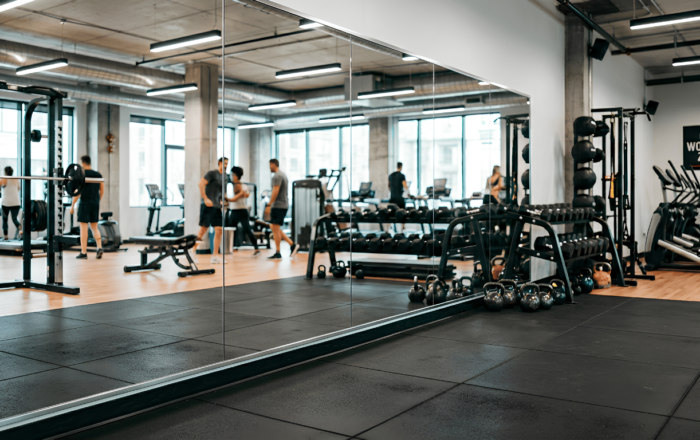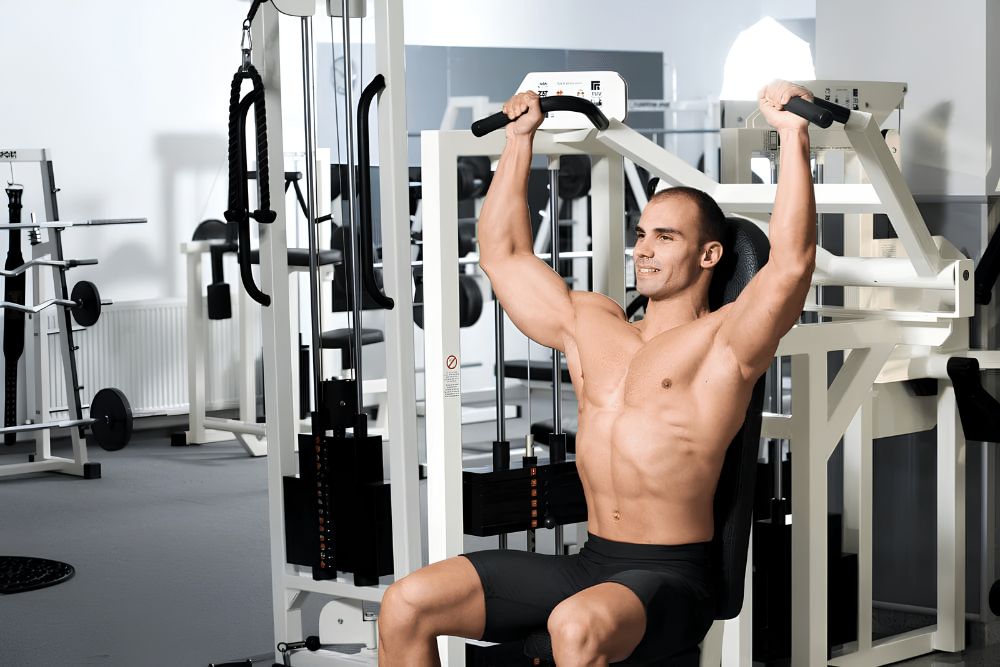
Walk through a busy gym and you will notice a pattern. The dumbbell bench is taken, the barbell rack has a queue, and the shoulder press machine has one person on it, scrolling between sets. Planfit’s sample of one million completed workouts shows how common that choice is: the machine press was logged 35,656 times, against 42,733 for the dumbbell version. That comes from Planfit’s own users, so treat it as a snapshot rather than a census. Still, plenty of lifters clearly use the machine. The better question is how to use it well.
What the Machine Does Better
The biggest thing a shoulder press machine removes is balance. With dumbbells, part of every rep goes toward keeping two weights from wandering. On the machine, the frame handles that, so more of your effort goes into the push.
That matters most at the end of a workout, or when you train alone. Taking a hard overhead set close to failure feels very different when there is no weight to drop. Many weight stacks also let you move up in smaller steps than a rack of dumbbells does, though that depends on the brand.
It is also a sensible place to learn the pressing pattern before you move to free weights.
Set Up Your Shoulder Press Machine Before You Add Weight
Most mistakes on a shoulder press machine start before the first rep. Sit with your head, upper back and hips against the pad and your feet flat on the floor. Adjust the seat so the handles start around shoulder level, with your elbows near a right angle. If the seat is too low, your arms get dragged behind your body at the bottom. If it is too high, you cut your range short. Grip just outside shoulder width.
Press until your arms are almost straight, without snapping the elbows into lockout, then lower the handles slowly. Skip the swing. Momentum takes tension off the muscle and hands it to the joint.
One small habit pays off quickly. Write down your seat number and the brand of the shoulder press machine in your training log. Settings differ between manufacturers, and a number saved without that detail is hard to use six months later. A decent test for load is that the last two reps feel hard but your back stays on the pad and your shoulders stay down. If your neck and upper traps burn more than your shoulders, lower the weight and recheck the seat before blaming the exercise. That is general coaching advice rather than a research finding.

Reading the Strength Standards Without Fooling Yourself
Strength Level publishes standards built from lifter logs. On the shoulder press machine, men are listed at 24 kg for beginner, 77 kg for intermediate and 115 kg for advanced, while women are listed at 8 kg, 34 kg and 56 kg. The dumbbell press tiers are much lower, with intermediate at 32 kg for men and 16 kg for women.
Please do not read that as a ranking of difficulty. Stack ratios, lever arms and pad angles differ from one machine to the next, so 60 kg in one gym may feel nothing like 60 kg in another. The useful comparison is you against your own log, on the same machine, in the same seat position.
Here is a simple way to apply that. Say you press 40 kg for 8, 8 and 7 reps. Next session, aim to get all three sets to 8 before you raise the weight. That small rule will do more for you than chasing a number from a table.
What Research Does and Does Not Say
Free weights have an edge in some muscle activation studies, but the evidence is thinner than gym lore suggests. A 1994 study of five trained lifters found higher anterior and medial deltoid activity in a free weight bench press than in a machine version. A later Smith machine comparison also found more medial deltoid work with the free bar, and the explanation offered was that the fixed straight path may not match the natural pressing arc.
Both studies looked at the bench press, in small groups, not at an overhead press. Another study, of sixteen men, found no significant difference in anterior deltoid activation between dumbbell pressing on a bench and on a Swiss ball, so extra wobble is not a magic ingredient either. What this question really needs is a direct trial of the shoulder press machine against dumbbells in trained lifters, and the studies above are not that. The fair summary is that machines probably trade some stabilizer demand for easier loading, but how big that trade is remains unproven.
A Practical Way to Program It
If your gym has dumbbells, press with them first while you are fresh, for example three sets of five to eight reps. Then move to the shoulder press machine for two or three sets of ten to fifteen. This puts the harder free weight work early and lets the machine add volume when your form on dumbbells would start to slip. It is a coaching approach, not a proven formula, so adjust it to how your shoulders respond.
If the shoulder press machine is all you have, three or four sets of eight to twelve is a sound place to start. Add lateral raises on another day, since a press is not the most direct way to train the side of the shoulder.
Finally, if you have a history of shoulder pain or impingement, or you feel sharp pain anywhere in the range on the shoulder press machine, stop and ask a physiotherapist or qualified coach before pressing overhead again.