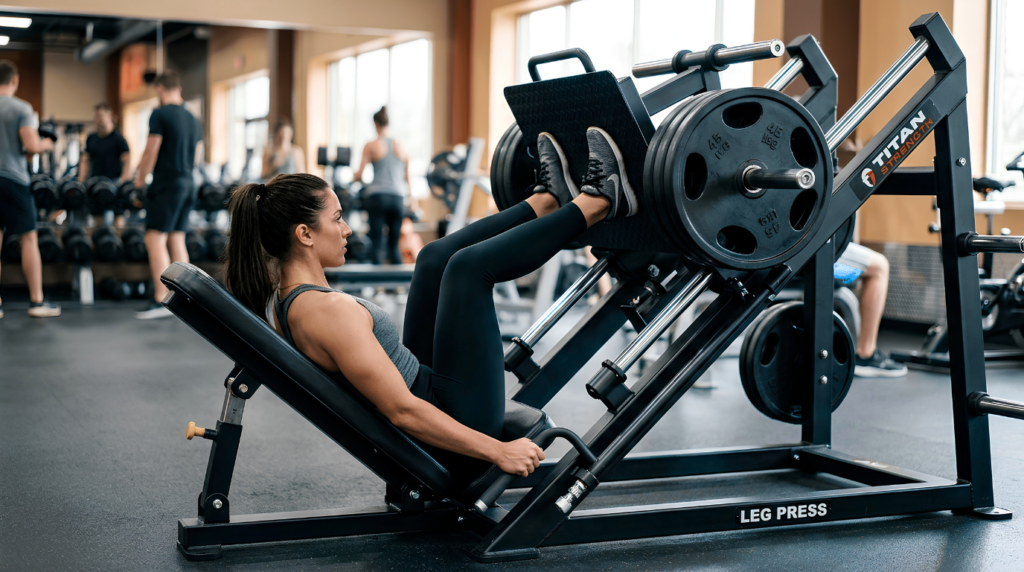
Most people use the leg press machine as a squat substitute: sit down, load the plates, push. A 2026 MRI study gives a more useful way to think about it. Over 12 weeks, the leg press grew the glutes and inner thighs as well as the quads, which the knee extension did not do. It also left one quad muscle almost untouched. That split should shape how you train legs.
What the MRI study found
Seventeen untrained adults trained one leg with knee extension and the other with the leg press, twice a week for 12 weeks at 70 percent of their one-rep max. Each person served as their own comparison, which makes the result fairer than comparing two separate groups. ovid
Growth in the vasti muscles and the whole quadriceps was comparable between the two exercises, and only the leg press significantly increased the gluteus maximus (15.4 percent) and the adductor magnus (6.2 percent). Per one breakdown of the paper, that added up to more total lower-limb growth for the press, about 6.3 percent against 2.8 percent. nihbiolayne
Keep the limits in mind. The volunteers were untrained, and beginners respond to almost any program, so results in experienced lifters may look different. The study also doesn’t say the leg press beats other glute exercises, because it never compared them.
The rectus femoris gap
The rectus femoris is the one quad muscle that crosses the hip as well as the knee. Knee extension grew it by 13.2 percent, while the leg press produced a gain of 1.1 percent that was not statistically significant. The authors suggest that extending the hip and knee at the same time may reduce rectus femoris activation. nihfisiologiadelejercicio
This is more than a cosmetic detail. The researchers note that the rectus femoris is highly susceptible to strain injuries. For runners and anyone who sprints or kicks, that muscle deserves direct work. nih
In practice, you can finish a session on the leg press machine with two or three sets of leg extensions. It adds a few minutes and fills the one gap the study found.
Leg press or squat?
The two exercises train different things, so choose based on what you want the work to do for you.
In an EMG study of 10 lifters, the squat produced greater quadriceps and hamstring activity than any leg press variation, with more stress at the knee. Strength transfer follows a similar pattern. In a ten-week trial, all groups raised their leg press 1RM by about 30 percent, but squat 1RM rose 32 percent in the squat-only group and only 8 percent in the leg press-only group. If your goal is a bigger squat, practice squatting. powerliftingtechniquestrengthlog
The leg press machine has its own advantages. A flywheel study found similar quadriceps activity in squat and leg press, with greater joint loading at the knee in the squat, and the authors suggested the leg press may be preferable from an injury-risk perspective. The seat supports your back and the sled follows a fixed path, so balance isn’t an issue and there is no bar to get pinned under. That makes it easier to push a set hard. The 2026 ACSM position stand says training within roughly two to three reps of failure is enough, and going to absolute failure is not necessary. nihgetfitcraft
A sensible rule of thumb is to squat, or use a close variation, when you want the skill and carryover. Use the leg press when your back, balance or mobility limits squatting, or when you want extra leg volume without more fatigue on your spine.
How to set up a leg press machine
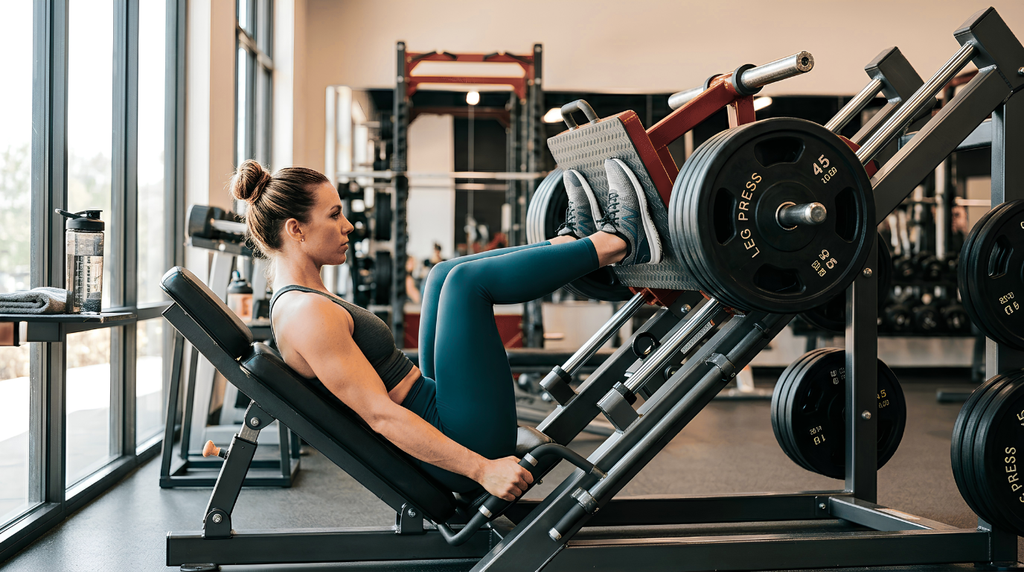
Depth. You don’t need to go as deep as the sled allows. In an 8-week trial of resistance-trained lifters, quadriceps growth was not significantly different whether they pressed deep or stopped short. The authors suggested that 90 to 100 degrees of knee bend may be enough to maximize quadriceps growth. Every leg press machine has a slightly different seat angle, so your real limit is your pelvis. Stop at the deepest point where your glutes and lower back stay on the pad. If your hips curl under at the bottom, you have gone too far. strengthlogtandfonline
A quick check is to have a friend watch from the side, or film one set. Your tailbone should not lift off the seat.
Foot placement. Gym folklore says high feet hit glutes, low feet hit quads, and wide feet hit inner thighs. The evidence is more mixed. A 2022 Sports Health study found no significant differences in muscle activation when stance width or foot rotation changed on the inclined leg press. Other work reports more glute and hamstring activity with a high foot position. Treat foot position as a small adjustment. Choose the stance where your heels stay flat and your knees track in line with your toes, and change it only if something feels better. gymnoteplus
Lockout. Press smoothly rather than snapping your knees into full lockout, and set the safety stops just below your working depth. ritfitsports
Mistakes that show up on this machine
Loading too many plates and cutting the range of motion is the most common one. The weight looks impressive, but the reps do less for you. Others include hips lifting off the seat, knees drifting inward, pushing on your thighs with your hands, and bouncing at the bottom. Slow the lowering phase until you can pause for a beat at the bottom without the weight dropping.
Weights are also not comparable from one leg press machine to another. Sled weight, angle and friction differ, so 200 kilos on one machine is not 200 kilos on another. Track your progress on the same machine.
A simple way to program it
The updated ACSM guidelines drew on 137 systematic reviews covering more than 30,000 participants. For muscle growth, they point to about 10 sets per muscle group per week. Training all major muscle groups at least twice a week is the baseline, and loads from 30 to 100 percent of 1RM all worked when sets were taken close to failure. ACSM Unveils Landmark 2026 Resistance Training Guidelines +2
Here is one way to use that, as an example rather than a prescription. Do two leg sessions a week. In each, do three or four sets on the leg press machine at a weight that leaves you two or three reps short of failure, then two sets of leg extensions and two or three sets of a leg curl. When all sets reach the top of your rep range with clean form, add a little weight.
If your goal is changing body composition, training is only half of it. How much you eat matters as much as how you train, so a tool like the Daily Calorie Calculator is a reasonable starting point for setting intake.
Choosing between machine types
A 45-degree sled supports the heaviest loading, while a vertical model has a smaller footprint and puts less stress on the lower back. The 45-degree sled is also the most common leg press machine in commercial gyms. Horizontal machines suit beginners who want a simple seated movement. For most home setups, plate-loaded models cost less and share plates with existing barbell equipment. If you are buying a leg press machine for home, measure your space first, because sled machines are long. extremetrainingequipmentextremetrainingequipment
Questions readers ask
Does the Leg Press Machine work the glutes? Yes. The MRI study above found significant glute growth in untrained adults. It did not test whether the press beats exercises built specifically for glutes.
Will it burn belly fat? No exercise removes fat from one area. Leg training builds muscle and uses energy, but fat loss depends on your overall energy balance.
Is the leg press machine safe with knee or back pain? The seated position helps some people, but it is not automatically safe. If you have pain or an injury, check with a physiotherapist or doctor before loading it.